


By Meredith Annex, Head of Clean Power, BloombergNEF
Global investment in renewable energy has reached new heights, soaring to a staggering $358 billion in the first six months of 2023. This represents a remarkable 22% increase compared to the same period last year and marks the highest-ever level of investment for any six-month period. These figures are based on the latest data from BloombergNEF’s Renewable Energy Investment Tracker report for the second half of 2023, published on August 21, 2023.
Record-breaking Investment in Solar Power
The driving force behind this exceptional performance in the first half of 2023 is solar energy. A remarkable $239 billion was invested in large- and small-scale solar systems, accounting for two-thirds of the total global investment in renewable energy during this period. This represents a staggering 43% increase compared to the first half of 2022.
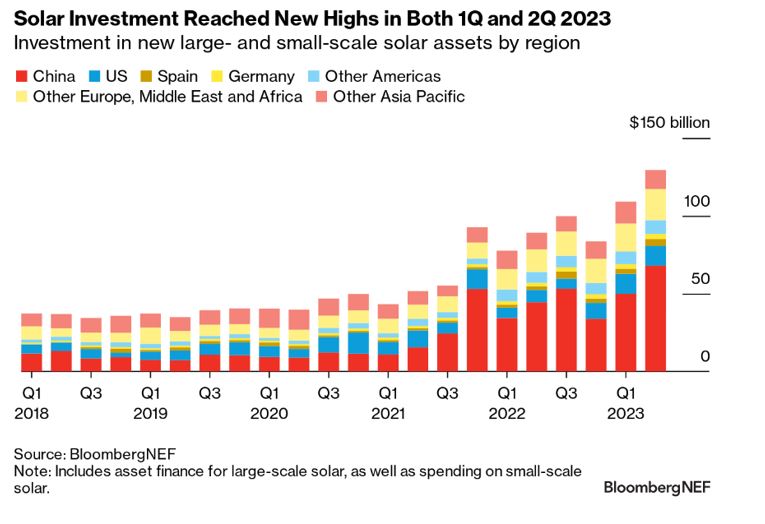
China played a significant role in this achievement, accounting for half of all large- and small-scale solar investment in the first half of 2023. Factors such as lower module prices, a robust rooftop PV market, and the commissioning of energy megabases in desert areas have driven China’s solar investment growth.
The United States emerged as a strong contender, with $25.5 billion invested in large- and small-scale solar during the first half of 2023. This represents an all-time record and an impressive 75% increase compared to the same period last year. The easing of supply chain constraints and the clarity provided by the country’s landmark Inflation Reduction Act (IRA) contributed to this remarkable growth.
Europe, the Middle East, and Africa (EMEA) also witnessed record-breaking investment in solar energy. Countries like Germany, Poland, and the Netherlands experienced a surge in demand due to Russia’s invasion of Ukraine and the subsequent energy crisis in Europe. In South Africa, power blackouts and new tax incentives fueled a record level of investment, while the NEOM PV plant for dedicated hydrogen production played a significant role in Saudi Arabia’s record six-month period of solar investment.
Wind Power Faces Challenges in Development
In contrast to the growth observed in solar investment, wind power investment declined by 8% compared to the first half of 2022, reaching $94 billion in the first half of 2023.
Onshore wind investment has been declining for four consecutive quarters. The sector received $64.5 billion of investment in the first half of 2023, a 21% drop compared to the same period last year. Grid constraints, permitting challenges, and faltering policy support in multiple markets have led to a reduced pipeline of ready-to-develop projects, which in turn has affected asset financing volumes. China accounted for two-thirds of onshore wind investment, with $38 billion invested in the first half of 2023. This marked a 22% decline compared to the same period last year.
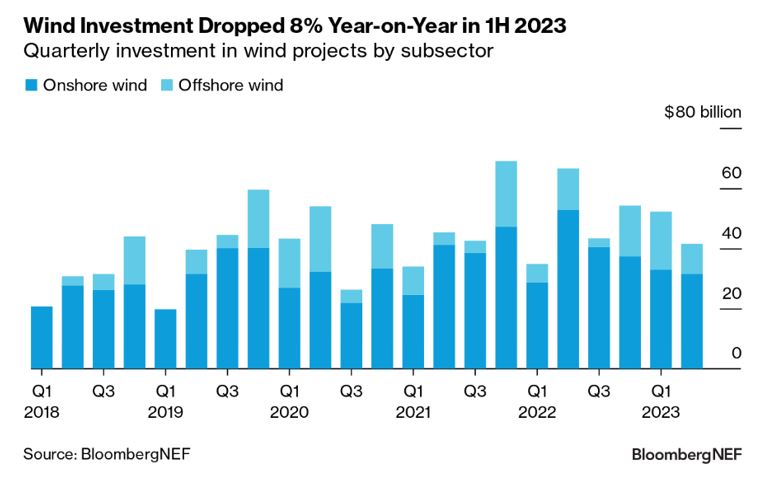
On the other hand, offshore wind investment experienced a robust increase of 47% relative to the first half of 2022, amounting to $29.2 billion during the first six months of 2023. Europe was responsible for the majority of this growth, with $9.4 billion more investment in offshore wind compared to the first half of 2022. Japan and Taiwan also witnessed a rise in offshore wind investments. However, the surge in offshore wind investment was unable to compensate for the decline in onshore wind investment at a global level.
A Long Way to Go for Net Zero
Despite the impressive investment figures, the rate of spending on renewable energy deployment, including both asset finance and small-scale solar, needs to increase by 76% to align with a net-zero trajectory.
According to BNEF’s New Energy Outlook, a total of $8.3 trillion must be invested in renewable energy deployment between 2023 and 2030 to stay on track for a global net-zero pathway by 2050 and keep global warming well below 2°C. This translates to an investment of $590 billion every six months via asset finance and small-scale solar. The $335 billion invested in the first half of 2023 falls significantly short of the required amount to achieve the net-zero goal.
Compared to other sectors of the economy, investment in renewable energy, especially in wind and solar, needs to be frontloaded to align with carbon budgets that aim to keep global warming well below 2°C. Clean power plays a critical role in supporting the decarbonization of other sectors, such as industry and transport, through greater electrification.
To read the full report, visit the BNEF website.
