



When it comes to investing, most people think of traditional investments like stocks, bonds, and cash. But there is a whole world of alternative investments that offer unique opportunities for investors. These investments, also known as alternative assets, go beyond the realm of traditional investments and can provide diversification and potentially higher returns.
What Are Alternative Investments?
Alternative investments are asset classes that differ from stocks, bonds, and cash. Unlike traditional investments, alternative investments are not easily sold or converted into cash. They are also more lightly regulated by the US Securities and Exchange Commission (SEC).
Alternative investments have low correlation with standard asset classes, meaning they don’t necessarily move in the same direction as other assets when market conditions change. They offer investors the potential for diversification and the ability to capitalize on unique market dynamics.
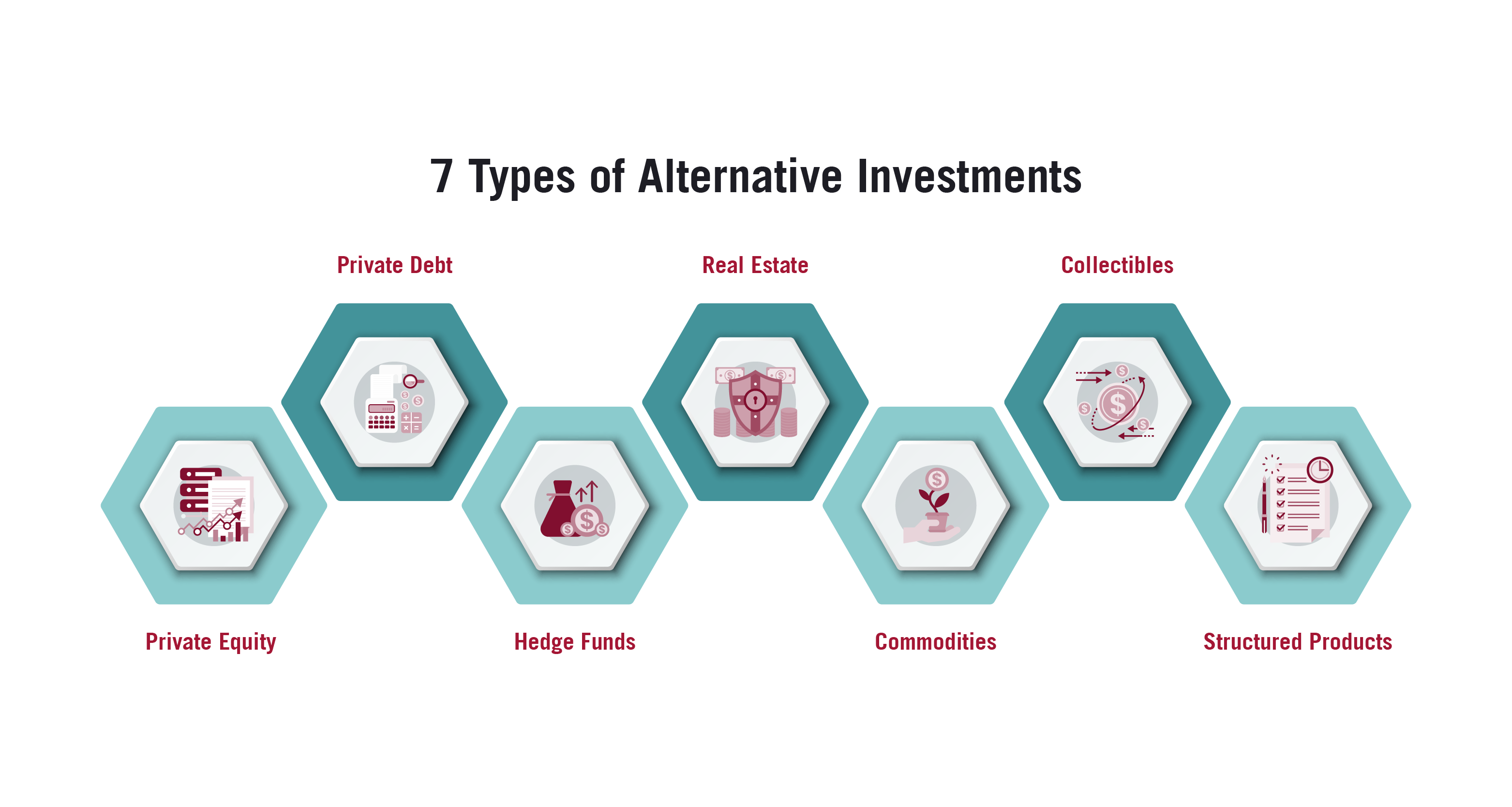
While alternative investments share these key characteristics, they encompass a diverse range of investment types. Here are seven types of alternative investments that everyone should know about:
1. Private Equity
Private equity refers to investments made into private companies that are not listed on public exchanges. There are different subsets of private equity, including venture capital, which focuses on early-stage companies; growth capital, which helps mature companies expand or restructure; and buyouts, which involve purchasing a company or its divisions outright.
Private equity firms not only provide capital but also offer industry expertise, talent sourcing assistance, and mentorship to the companies they invest in. This close relationship between the investing firm and the company receiving capital sets private equity apart from other forms of investment.
2. Private Debt
Private debt refers to investments that are not financed by banks or traded on open markets. It provides additional capital to companies for their growth and expansion. Private debt funds issue the capital and make money through interest payments and loan repayment.
Unlike public debt, private debt offers investors the potential for higher returns and more flexibility. It can be an attractive alternative for companies that may not meet the criteria for traditional bank financing.
3. Hedge Funds
Hedge funds are investment funds that employ various strategies to earn high returns. They trade relatively liquid assets and can specialize in different areas such as long-short equity, market neutral, volatility arbitrage, and quantitative strategies. Hedge funds are typically available only to institutional investors and high-net-worth individuals.
Hedge fund managers have the freedom to pursue unconventional investment strategies and aim to outperform traditional market indices. They can provide diversification and potentially higher returns but also come with higher risks.
4. Real Estate
Real estate is one of the most common types of alternative investments and the largest asset class in the world. It includes properties such as land, residential and commercial buildings, and intellectual property like artwork. Real estate offers investors the potential for both current cash flow from rental income and long-term capital appreciation.
Valuing real estate can be challenging, and investors need to develop strong valuation skills to make informed investment decisions. Different valuation methods, such as income capitalization and discounted cash flow, are used in real estate investing.
5. Commodities
Commodities are real assets that include natural resources like agricultural products, oil, natural gas, and precious metals. They are considered a hedge against inflation and have historically shown low correlation with public equity markets. The value of commodities rises and falls based on supply and demand dynamics.
Commodity markets have a long history and provide opportunities for investors to profit from price fluctuations. Investing in commodities requires understanding market fundamentals and monitoring global economic trends.
6. Collectibles
Investing in collectibles involves purchasing and maintaining physical items with the expectation that their value will appreciate over time. Collectibles can include rare wines, vintage cars, fine art, and stamps, among other items. These investments offer a unique combination of enjoyment and potential financial returns.
However, investing in collectibles can be risky due to high acquisition costs, lack of income until the items are sold, and the need for expertise in the specific collectible category. Successful collectibles investors often have deep knowledge and a passion for their chosen niche.
7. Structured Products
Structured products combine fixed income markets and derivatives. They offer investors customized product mixes to meet their individual needs. Examples of structured products include credit default swaps and collateralized debt obligations.
Structured products can be complex and come with risks, as seen during the 2007-2008 financial crisis. It’s essential for investors to have a clear understanding of the underlying assets and the associated risks before investing.
Deciding to pursue a career in alternative investments requires considering your professional goals and the asset classes that interest you the most. Alternatives offer a wide range of liquidity, industry exposure, and time horizon options.
Alternative investments provide greater portfolio diversification and the potential for higher returns. As these investments become more accessible to different types of investors, they are increasingly important to know for both individual investors and investment professionals.
Do you want to explore the world of alternative investments? Check out our five-week online course on Alternative Investments and gain the confidence and skills to assess potential investment opportunities and maximize the value of your portfolio. Download our free Financial Terms Cheat Sheet to jumpstart your financial literacy journey.
This article was originally published on Investment.
