


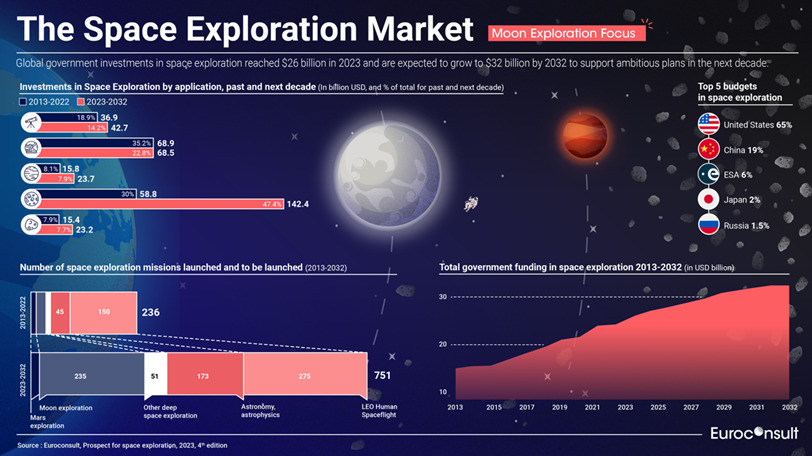
Global government space exploration funding reached an impressive $26 billion in 2023 and is projected to soar to nearly $33 billion by 2032. In Euroconsult’s latest ‘Prospects for Space Exploration’ report, key areas of growth include lunar exploration, low Earth orbit (LEO) human spaceflight, and Mars exploration. The report also highlights the emerging lunar exploration duopoly between the U.S.-led Artemis program and China’s International Lunar Research Station (ILRS), as well as increasing private sector involvement.
Lunar Exploration: The Catalyst for Growth
Lunar exploration is the driving force behind the unprecedented surge in the space exploration sector. Ambitious lunar missions have propelled global government investment to $26 billion in 2023, with projections indicating a significant boost to nearly $33 billion by 2032. This growth trajectory underscores the pivotal role of lunar exploration in shaping the future of space exploration. Euroconsult’s ‘Prospects for Space Exploration’ report reveals these figures and highlights the exponential market expansion that is anticipated to fuel global investment in the coming years.
Moon exploration is expected to achieve a remarkable 5% 10-year compound annual growth rate (CAGR), reaching nearly $17 billion by 2032. The surge in funding will primarily support upcoming human spaceflight missions, necessitating substantial investments in transportation and orbital infrastructure. Furthermore, increased investments in robotic lunar missions will pave the way for a sustained human presence on the Moon.
Human Spaceflight in Low Earth Orbit (LEO)
The second-largest investment stream in space exploration is human spaceflight in LEO. Although this area experienced a decline in recent years following the completion of major government and public-private programs, a new investment cycle is on the horizon. It is expected to peak at $7 billion by 2030, supporting the final years of operation and decommissioning of the International Space Station (ISS). Additionally, increased investments will ensure a smooth transition of post-ISS LEO operations into the private sector.
Mars Exploration on the Rise
Investments in Mars exploration are steadily growing, with a projected 2% 10-year CAGR, surpassing $2.5 billion by 2032. These investments will primarily focus on planned missions, particularly sample-return missions, which will contribute to the growth of this sector.
Deep Space Exploration and Astrophysics
Other funding for deep space exploration is predicted to continue on an upward trajectory, averaging around $2 billion by 2025. This emphasizes the ongoing global commitment to exploring the far reaches of our solar system. Astronomy, astrophysics, and heliophysics, with a current annual spend level of $4 billion, are expected to remain significant fields of interest for space agencies worldwide.
An Era of Increased Missions
The coming decade is poised to witness a surge in space exploration missions, with a total of over 750 missions, representing a substantial increase from the previous 10 years’ count of 236. Human spaceflight in LEO will dominate, accounting for 36% of the total, closely followed by lunar exploration at 31%. The commercial space exploration sector is also on the rise and will comprise 31% of the total missions, driven by both LEO and lunar exploration endeavors.
The Focus on Lunar Exploration
The focus on lunar exploration is driven by a blend of strategic and geopolitical motivations. Establishing a sustainable presence on the Moon is considered a pivotal step toward enabling future human missions to Mars. This has resulted in the emergence of a duopolistic context in lunar exploration, with the U.S.-led Artemis program and China-led International Lunar Research Station (ILRS) program taking center stage.
Natalia Larrea, Director of Euroconsult USA, emphasizes that this new era in space exploration is marked by collaboration and competition. The main global focus is establishing a sustainable lunar presence while maintaining a sustained LEO human presence. The private sector is also playing an increasingly significant role, with numerous companies seeking to provide commercial services in space exploration.
Challenges and Risks
Euroconsult’s ‘Prospects for Space Exploration’ report highlights the existence of challenges and risks in the sector. Business cases still heavily rely on government contracts in the near- and medium-term, emphasizing the need for sustainable economic models as the lunar and LEO economies continue to develop.
Overall, the future of space exploration looks promising. With increasing investment, strategic partnerships, and a booming commercial sector, the next decade will witness remarkable advancements and discoveries that shape the future of humanity’s exploration of the cosmos.
