

A common argument for supporting early childhood programs is that they offer a high return on investment (ROI). But what does this really mean, and how can it benefit both children and society as a whole? In this article, we explore the concept of ROI in early childhood programs and delve into the reasons why investing in these programs can yield significant long-term gains.
What does it mean to “invest” in early childhood?
In financial terms, an investment involves allocating money with the expectation of receiving a return in addition to the initial amount invested. Early childhood programs require financial resources, but research shows that the benefits derived from these programs often outweigh the costs. When the projected benefits exceed the projected costs, these programs can be considered as “paying for themselves” and generating a financial return.
Who benefits from early childhood programs?
The primary beneficiaries of early childhood programs are children and their parents. By enrolling their children in high-quality daycare or preschool programs, parents provide them with access to a wider range of learning opportunities. Additionally, this enables parents, particularly low-income parents, to pursue employment or further education, leading to improved career prospects. The individual benefits for children and parents can be substantial and life-changing.
However, the benefits extend beyond the individual level. State and local governments, as well as taxpayers and society as a whole, also benefit from high-quality early childhood programs. These programs promote healthy development and reduce the need for costly interventions later in a child’s life, such as special education, grade repetition, early parenthood, and incarceration. Furthermore, children and parents who participate in these programs are more likely to be employed, contributing positively to the economy through tax revenue and increased buying power.
How substantial are the returns on early childhood programs?
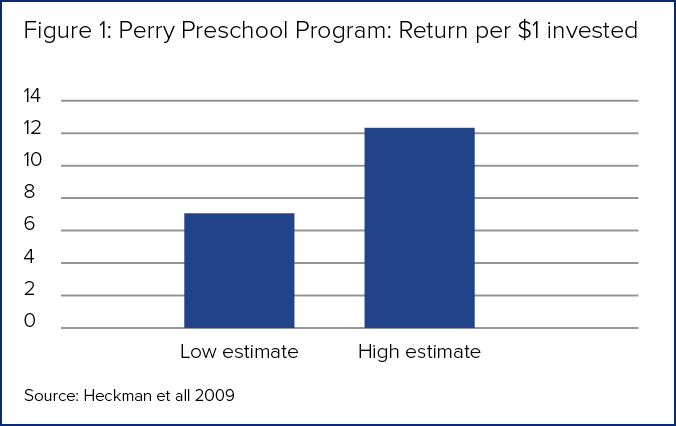
The returns on early childhood programs can be significant. For instance, the National Forum on Early Childhood Policy and Programs found that high-quality programs can yield a return of $4 to $9 for every dollar invested. A study of the Perry Preschool program, a high-quality program developed in Michigan in the 1960s, estimated a return to society of $7 to $12 for each dollar invested. These findings highlight the potential for substantial returns in the long term.
Do all early childhood programs provide the same benefits and returns?
No, there is a range of outcomes and returns among different early childhood programs. A landmark study found that five out of seven programs examined had a positive cost-benefit ratio, but the benefits and returns varied among the five. Additionally, some studies suggest that investing in a child’s early years yields higher returns on investment. Nobel Prize-winning economist James Heckman argues that returns on investments made in the earliest stages of a child’s life are generally higher. However, programs targeting older age groups can still generate positive returns.
How are benefits or returns calculated?
Estimating the benefits associated with early childhood programs involves linking costs and outcomes. Different approaches exist to evaluate these benefits, and economists assign values, often in dollar terms, to non-economic outcomes to determine their worth. While some outcomes are challenging to monetize, such as a child’s love for reading, others, like reduced emergency room visits, can be easily quantified. It’s essential to consider the quality of evaluation data and the underlying assumptions when assessing the return on investment.
How should I assess the return on investment when choosing programs to support?
Comparing potential programs based on a common measure, such as cost-benefit analysis, can be helpful but may not be suitable in all cases due to the varied goals and evaluation methods across programs. Donors should keep the following in mind:
- Different programs track different outcomes, so returns alone may not guarantee specific desired outcomes.
- A program may show a negative return if it doesn’t work, if the costs outweigh the benefits, or if the evaluation data and assumptions are flawed.
- Returns on investment can differ based on the location or population targeted.
- Consider the cost involved in different approaches and use a cost-per-impact analysis to gauge the “bang for buck” while considering the unique impact of each program.
Investing in early childhood programs offers a compelling ROI and has the potential to transform lives and benefit society. By supporting these programs, we invest in the future and create a more prosperous and inclusive world.
Additional Resources
- Heckman Equation: Explore James Heckman’s research and resources on early childhood investments.
- Towards Standardization of Benefit-Cost Analysis of Early Childhood Interventions: A detailed analysis by Lynn Karoly discussing the challenges of comparing costs and benefits of early childhood programs.
- The Economics of Early Childhood Policy: An overview of different approaches to estimating economic returns in early childhood programs.
- Early Childhood Interventions: Proven Results, Future Promise: A comprehensive study of the impact and return on investment for various early childhood programs.
- Measuring and/or Estimating Social Value Creation: A review of different approaches to integrating costs and benefits of social programs, including cost-per-impact analysis.
- TEDx talk by Professor Larry Schweinhart on returns to high-quality preschool: A talk by Dr. Larry Schweinhart on the benefits and returns of high-quality preschool programs.
- The Business Case for Early Childhood Education: A New York Times op-ed discussing the business perspective on early childhood education.
- Georgia Early Education Alliance for Ready Students (GEEARS) video: An animated video highlighting the case for investment in early childhood.
- Ready Nation: A national alliance of business leaders advocating for early childhood education.
